
Juneteenth
A New Federal Holiday

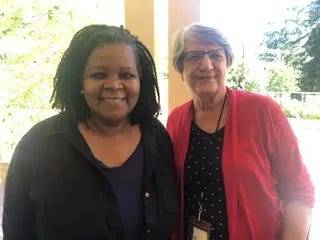
Before I launch into today’s topic, I want to take a few sentences to thank all of you who reached out to me after my “I Am Weary” post last Friday. I am grateful to each of you individually, and all of you collectively. You prove once again that there is still kindness, compassion, and care for one another in abundance in our society. That matters very much. I am well. Still a lot to juggle, but we’ve formed a team and life has settled into a manageable new routine. On to the topic of the day.
I met Harvard professor and author Annette Gordon-Reed at Chautauqua in New York. She spoke about her book, On Juneteenth. In honor of today being Juneteenth, I’m providing a quick overview of our newest federal holiday and a little of the history of enslavement in the earliest years of what became the United States 250 years ago.
Juneteenth was established as a federal holiday June 17, 2021. It commemorates June 19, 1865, the day Union soldiers arrived in Galveston, Texas to announce the Emancipation Proclamation of January 1, 1863. Texas slaveholders outnumbered Union people by a large margin, so the practice of using enslaved people for labor continued for two more years after the Emancipation Proclamation.
Juneteenth was first celebrated in Texas in 1866, when formerly enslaved people gathered to pray, read the Emancipation Proclamation, and enjoy music and food. I’d never heard of it until I moved to Texas in the early 80s. More about Professor Gordon-Reed and her work in Tuesday’s People of Hope post. For now, let’s consider how slavery was introduced to North America.
The White Lion
The White Lion was an armed private English ship that arrived at Point Comfort, Virginia, in August 1619, a year before the Mayflower sailed into Cape Cod Harbor. It brought over twenty Africans who’d been captured from a Portuguese ship to trade with Virginia colonists for food and supplies. Soon after the White Lion arrived, the Treasurer arrived with more enslaved Africans. At the time, their legal status was ambiguous since some may have been indentured servants, as were several of the Mayflower passengers. Others were considered chattel slaves. Virginian slave owners made their status as such legal by law later in the 17th century.
Slavery in Massachusetts
Though we generally think of slavery as a phenomenon of the southern colonies, there were also enslaved people in Massachusetts. In 1641, the colony became the first one to legally acknowledge slavery through the Massachusetts Body of Liberties. The law permitted slavery in cases of lawful captives captured in a just war or people willing to sell themselves into bondage. The concept of “lawful captives captured in a just war” led to enslaving Indigenous people along with imported Africans.
I interviewed an elder of the Pokanoket nation while researching my historical novel, Mayflower Chronicles: The Tale of Two Cultures. During the interview, he said, “Brewster. I have the name Brewster in my family tree. Do you think your people once owned my people?” I was mortified. I’d never uncovered such data, but the Brewster family is quite large and far-flung. I know some fought in the Revolutionary War. It’s quite possible others fought in the Pequot and King Philip’s War. To date, I’ve found no evidence that any of my ancestors owned any of his ancestors. I just do not know.
Massachusetts merchants found the slave trade lucrative, especially in Boston and Salem. Merchants there participated in the transatlantic triangle: goods were shipped to Africa, enslaved people were shipped to the Caribbean and colonies, and sugar and rum were shipped to New England. For a period of time, enslaved people comprised a small but significant portion of the Massachusetts population. Some of the enslaved were Indigenous people taken into slavery after clashes with English settlers.
Massachusetts played an important role in the abolition movement, beginning in 1783 with a series of court cases. One involved Elizabeth Freeman. Less than a year after the Massachusetts State Constitution was adopted, this brave enslaved woman challenged the document’s promise of liberty because she did not enjoy it. Born as “Mum Bett,” Elizabeth Freeman convinced the court through a lawsuit that she, too, had the right to be free. Hers was one of a group of “freedom suits” that eventually convinced the Massachusetts Supreme Judicial Court to outlaw slavery in that state. On January 12, 1773, the new declaration stated that “mankind in a state of nature are equal, free, and independent of each other, and have a right to the undisturbed enjoyment of their lives, their liberty and property.”
Plymouth Plantation
A few of the Mayflower passengers traveled with their personal servants, and others traveled as indentured servants. However, slavery as we typically think of it wasn’t initially part of the Pilgrim settlement in Plymouth. The early settlers were few in number and faced overwhelming struggles. Everyone needed to work to ensure survival.
That changed by the mid-to-late 17th century when some Plymouth residents acquired enslaved Africans, along with enslaved Indigenous people, especially after King Philip’s War (1675 - 1678). Anglo colonists sold hundreds of defeated Indigenous people into slavery, some as far away as the Caribbean. The enslavement was sanctioned by Plymouth’s government.
Peregrine White, the first English baby born after the Mayflower arrived in Cape Cod, lived to see slavery incorporated into the New England economic system. Though she did not participate in that, other prosperous, later-arriving colonists did. Plymouth was absorbed by the Massachusetts Bay Colony in 1691 and thereafter operated according to Massachusetts’ evolving slave laws.
Learning More to Do More
There is a movement unfolding across our country to deny, rewrite, or at least bury far out of sight, the uglier parts of our history. I don’t write about these things to instill guilt in anyone. Those alive today were not there making decisions about enslaving or freeing enslaved people. We are not responsible for the wrongs of the past. But we do have an obligation to learn about them and resolve to do better going forward. Ignoring or denying history allows the wounds of injustice to continue to fester and erupt in more violence and cruelty.
Acknowledging that these ugly things happened allows us to be better people today. I feel no guilt for what my ancestors did. I do feel a huge obligation to do my part in promoting peaceful relations with people of all cultures, religions, and ethnic heritages. It is that obligation that prompts me to research all of the various chapters of history, the good and the ugly. I am convinced, and the evidence shows, that ultimately, when enough of us care, we can right the wrongs of the past.
Though I am as Caucasian as they come, I rejoice that Juneteenth has been designated a federal holiday.
This post is based in part on information from www.womenshistory.org

Mary Brewster’s Love Life: Paperback, hardback, audio, and eBook. Bookshop.org
Mayflower Chronicles: Paper, audio, eBook. Bookshop.org
Asunder: Paper. HowWiseThen.com
A Ready Hope: Paper, eBook. Bloomsbury.com
40 Day Journey with Kathleen Norris: Paper. Augsburg Fortress
God in the Raging Waters. Paper. Amazon.com
Married & Mobile. Paper. HowWiseThen.com
Thank you for explaining this holiday.